
Infrastructure Assurance·Network Operations
The Inspection That Happened but Cannot Be Proven
Construction can be inspected and accepted while engineering records remain inaccurate. Explore the evidence gap between field execution and network operations.
The Evidence Gap · Part 01
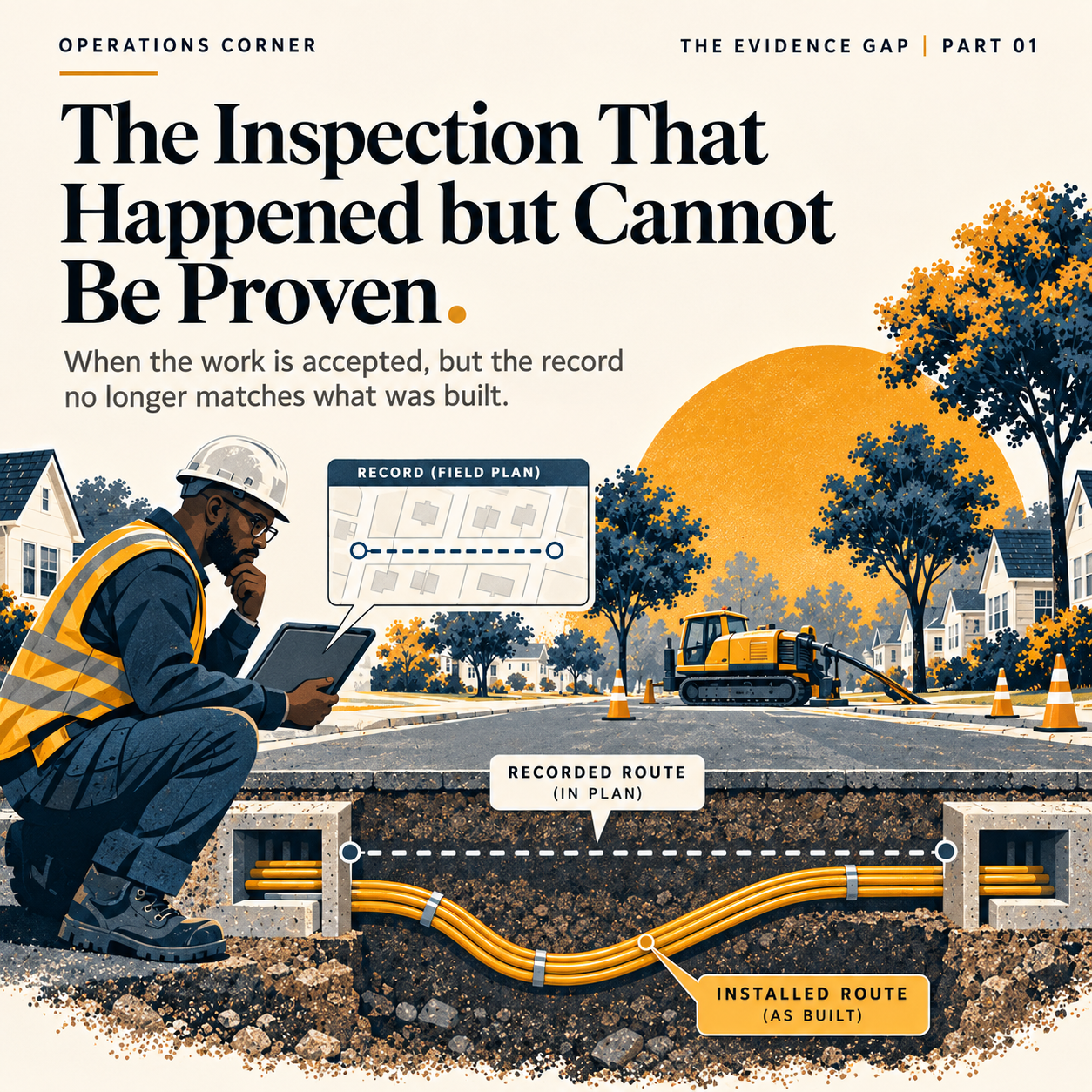
A directional drilling crew encounters an obstruction along an approved fiber route. The bore path must be adjusted. Depending on the deviation, the change may fall within permitted tolerances or require additional engineering and regulatory approval.
The crew makes the necessary adjustment and completes the installation.
Modern directional drilling equipment can generate detailed bore profiles, recording the drill head's path and depth. Walkover locating systems can also provide rod-by-rod measurements, although the quality of the resulting record depends on how those observations are captured and preserved.
The information needed to document the deviation may already exist.
Months later, the network's engineering records still show the original alignment.
The construction may have been completed correctly. The inspection may have taken place. Yet the operating record no longer accurately represents what was installed.
When another contractor eventually excavates near that facility, the difference between the recorded and actual alignment may become considerably more important than it seemed during construction.
This is one of the persistent problems in telecommunications infrastructure. We have become remarkably comfortable with the expectation that construction records will contain inaccuracies, even as the technology available to capture and preserve field information has improved substantially.
The Reality of Construction
A typical fiber construction project involves multiple crews working across different locations, often simultaneously.
One team may be drilling while another installs underground structures. Cable placement, splicing, testing, traffic control, and restoration follow their own schedules and dependencies.
Construction managers coordinate these activities, resolve field issues, monitor production, and oversee compliance with project requirements. But even the most capable construction manager cannot observe several active work locations simultaneously.
Some projects address this limitation through continuous field observation, often described as Watch and Protect.
Dedicated personnel remain on site to monitor construction activities and identify concerns as work progresses. Such arrangements can be appropriate, particularly around sensitive infrastructure.
Extending that level of supervision across an entire construction program, however, introduces significant cost.
A contractor bidding competitively may struggle to justify assigning an experienced construction manager to every active crew for forty or more hours each week. The alternative is often to deploy less experienced observers whose primary function is to monitor activities and report concerns.
These individuals provide useful visibility, but observation is not necessarily technical verification.
An observer may witness a measurement being taken without possessing the competence or authority to determine whether the installation satisfies engineering requirements.
The construction manager remains responsible for multiple activities, while the inspection process depends heavily on what individual personnel happen to observe.
And much of the work becomes inaccessible once the crew moves forward.
An open trench can be measured before backfilling. A buried conduit cannot be inspected in the same manner afterward. A completed splice closure may have passed optical testing without anyone preserving a reliable record of its internal configuration.
The opportunity to verify certain conditions exists only at particular stages of construction.
Production, Constraints, and Incentives
Construction vendors generally have little commercial interest in producing substandard work.
Quality failures create rework, additional mobilization costs, payment disputes, and damaged customer relationships. A crew returning to repair an avoidable defect consumes resources that could have been deployed on revenue-generating work elsewhere.
The difficulties often emerge from the realities of project execution.
A contractor accepts work based on estimated quantities, expected site conditions, production rates, available resources, and contractual schedules.
Then construction begins.
An obstruction changes the proposed alignment. Utility conflicts require additional coordination. Ground conditions affect drilling productivity. Permit restrictions shorten the available work window.
The contractor must respond while managing equipment costs, labor commitments, project milestones, and the requirements of subsequent work.
An acceptable adjustment may be available, but obtaining engineering approval or amended permits can take longer than the immediate construction problem.
The pressure to maintain production does not eliminate the obligation to comply with the design and applicable standards. It does, however, explain why field changes occur within a commercial environment that rarely rewards prolonged inactivity.
Some adjustments are permitted within established construction tolerances. Others require formal authorization. Still others reveal deficiencies in the original engineering assumptions.
All must be handled appropriately.
But even when a deviation is legitimate and properly approved, a second obligation remains: ensuring that the final engineering record reflects what was actually installed.
Where the Evidence Disappears
Construction inspection and construction documentation are closely related, but they serve different purposes.
An inspector may establish that work meets an applicable requirement. An engineering record must preserve sufficient information for future users to understand the installed infrastructure.
A signed inspection report does not necessarily accomplish both.
Consider a bore profile recorded during construction. The field team may possess measurements showing the actual drilling path, including changes made to navigate obstructions. That information may exist in an equipment-generated file, a locator's notes, or a construction supervisor's records.
If those observations are not associated with the correct work package, reconciled against the approved design, and transferred into the final engineering record, much of their value is lost.
The same applies to revised structure locations, cable assignments, splice configurations, and approved material substitutions.
Many organizations already require redlined construction drawings and as-built submissions. The weakness is not necessarily the absence of a documentation requirement.
It is the continuity of information between field execution, inspection, engineering, and final acceptance.
Ontario's Building Broadband Faster guidance explicitly recognizes this process. It calls for field changes to be incorporated into final drawings and emphasizes inspection while buried infrastructure remains accessible.
Yet the existence of a defined process does not guarantee that the information moves through it reliably.
A project can be administratively closed while discrepancies remain between its engineering records and the installed network.
Years later, the maintenance organization inherits those discrepancies without necessarily knowing they exist.
Beyond the Photograph
Photography has become a common response to concerns about construction quality.
A technician may be required to photograph a trench with a ruler demonstrating burial depth. Another photograph may document a handhole installation or completed splice closure.
These records can be useful, but their evidentiary value depends on more than the image itself.
A photograph showing compliant burial depth at one location does not establish compliance across an entire route.
A timestamp and location record provide context, but neither independently establishes that the measurement was accurate or that the photograph represents the final installed condition.
There is also a distinction between proving compliance and documenting a deviation.
Suppose a crew encounters an obstruction and makes an approved adjustment. The revised installation may satisfy every applicable requirement, yet still differ from the original drawing.
A photograph demonstrating compliance does not necessarily communicate the change to engineering.
The network owner needs both pieces of information: evidence supporting the installation's acceptance and an accurate description of what was installed.
Modern capture technology makes it increasingly practical to associate measurements, photographs, instrument records, locations, and field changes with specific construction activities.
The objective should not be to produce more photographs or longer inspection checklists.
It should be to preserve the information needed to establish what happened, determine whether it was acceptable, and maintain an accurate record of the resulting asset.
That includes preserving original observations when corrections are required, rather than replacing the history with a final compliant result.
Technology cannot eliminate every measurement error or substitute for engineering judgment. Even a detailed bore log has accuracy limitations and does not automatically prove the exact final position of an installed conduit.
But it can significantly improve the information available for verification and future operations when supported by suitable procedures and competent personnel.
What Operations Inherits
An inaccurate network record is rarely confined to the project that produced it.
Its consequences emerge during future construction, maintenance, fault isolation, capacity expansion, and emergency restoration.
A technician dispatched to investigate a damaged facility may discover that the route differs from the engineering drawing. A splicing crew may encounter assignments that do not match the recorded configuration. A locating contractor may have to establish the position of infrastructure that should already be documented.
Each discrepancy introduces uncertainty into work that depends on reliable information.
Sometimes that uncertainty results only in additional investigation. In other circumstances, it can contribute to service disruption, excavation damage, delayed restoration, or unnecessary expenditure.
The original construction project may have been accepted and financially closed years earlier.
The cost of resolving its information gaps now belongs to operations.
We have sophisticated engineering platforms, digital measurement tools, electronic construction records, and increasingly capable field devices. The industry has far greater opportunities to capture reliable information during construction than it did when field records depended almost entirely on handwritten notes and manually updated drawings.
Yet collecting information is only half the process.
The evidence must survive the handoffs between the people performing the work, those verifying it, the engineers responsible for maintaining the records, and the teams that will eventually operate the infrastructure.
Construction assurance should establish more than whether an installation was acceptable at the moment of inspection.
It should leave the infrastructure owner with a defensible account of what was built.
An inspection can be completed correctly and still leave that responsibility unfinished.
The standard should no longer be that our records are approximately correct until someone in the field discovers otherwise.
For infrastructure expected to remain in service for decades, we have the means to demand better.
References
Ontario Ministry of Infrastructure, Building Broadband Faster, Version 2.0 (2022)
HDD Consortium, HDD Good Practice Guidelines
ASCE, Pipeline Design for Installation by Horizontal Directional Drilling, Chapter 6 (2024)