
Telecommunications·Maintenance Economics
Fiber Is Passive. Maintenance Is Not.
The broadband industry learned how to build fiber at extraordinary speed. Maintaining what it built may require a different kind of investment.
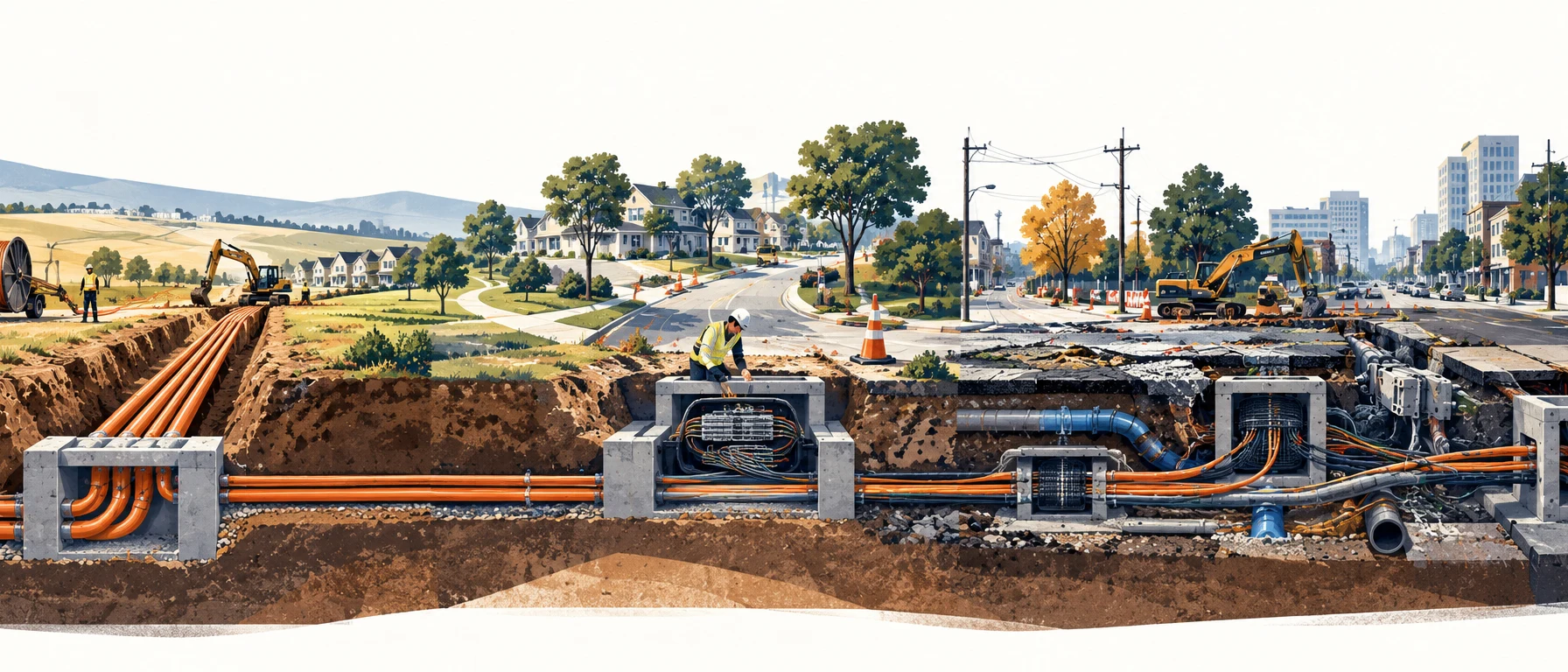
What Left With the Experienced Technician
For years, the operating case for fiber has been compelling.
Compared with legacy copper and hybrid fiber-coaxial networks, fiber-to-the-home removes active components from much of the outside plant, consumes less power and generally requires fewer fault-related dispatches. An analysis published by the Fiber Broadband Association estimated access-network operating expenses for FTTH at approximately 50 percent below HFC and 63 percent below DSL in the scenarios it examined.
On paper, the direction seems obvious. Build more fiber and the maintenance burden should decline.
The physical medium, however, is only one part of the operating system.
A fiber network still has to be located, accessed, diagnosed, repaired, documented and returned to service. Its records have to remain aligned with the infrastructure in the field. Technicians have to distinguish one failure condition from another. Contractors have to make decisions under restoration deadlines. Repairs have to survive long after the trouble ticket closes.
Across mature broadband markets, these operational questions are becoming harder to ignore.
The industry became exceptionally good at building fiber.
It is now learning what it takes to live with it.
I entered telecommunications in an era when technical development required considerable time.
At AT&T, I was sent away for multi-week technical courses. Splicing training began with basic electrical principles before progressing into the physical work. We learned to splice large copper cables, including exercises that required taking a 300-pair cable and dividing it into 200-pair and 100-pair configurations.
Repair training went further.
Training boards were deliberately faulted. A circuit might contain an open or a short somewhere along its path. The assignment was not simply to replace something until the circuit worked. We had to understand the circuit, interpret what we were seeing, isolate the problem, make the repair and test again.
Earlier test methods often forced the technician to reason through the electrical behavior of the circuit. Modern fiber instruments can perform much of that interpretation automatically. Fusion splicers evaluate splice quality. Optical test equipment can process measurements and present results in increasingly accessible ways. An operator can sometimes receive an apparent pass/fail result without understanding the underlying trace, backscatter, dead zones or wavelength-dependent behavior that produced it.
The instruments have become considerably more capable.
That does not automatically make the technician more diagnostic.
Maintenance still begins with uncertainty.
A customer reports no service. That symptom does not tell the technician where the problem is. The failure may be at the premise, along the drop, at a splice, farther upstream or the result of something that happened to the network hours earlier.
The technician has to turn a symptom into a diagnosis.
That capability takes time to develop.
The broadband industry is now confronting a significant workforce transition. A workforce study commissioned by the Fiber Broadband Association and Power & Communication Contractors Association estimated that approximately 119,200 additional construction workers and technicians would be required over a ten-year period simply to replace workers lost through retirement and attrition.
Replacing the person does not immediately replace the experience.
A new technician can learn how to operate a fusion splicer. A course can teach the correct sequence for preparing fiber. Procedures can establish required light levels and closeout requirements.
Experience supplies something else.
It builds pattern recognition. It teaches the technician what an unusual reading might indicate, which questions to ask next and when the obvious repair may not explain the entire condition.
That knowledge accumulates through training, repetition, mistakes, mentorship and years spent interacting with physical networks.
There is no three-day course for twenty years of troubleshooting.
The Expansion Years
The workforce transition arrived alongside one of the largest broadband construction cycles in recent history.
Capital was available. Governments committed billions to broadband expansion. Private investment accelerated. Operators raced into new markets while established providers expanded fiber deeper into existing footprints.
The primary operating question was understandably centered on construction:
How quickly can we build?
Homes passed became a defining measure of progress.
Construction capacity expanded through contractors and subcontractors capable of moving crews and equipment rapidly between markets. Outsourcing offered operators access to specialized labor, equipment and geographic scale without carrying the entire workforce permanently inside the organization.
The model helped the industry build quickly.
Maintenance asks a different question.
What happens after the network has been in the ground for five, ten or twenty years?
The installed base accumulates history.
Roads are widened. Utilities relocate. New developments appear. Contractors excavate nearby. Handholes are opened. Splices are modified. Drops are replaced. Storms occur. Pavement is reconstructed. New customers are connected. Old customers disconnect. Records are updated, partially updated or sometimes not updated at all.
The network that exists ten years after construction is no longer simply the network shown on the original design.
Someone has to understand what it became.
When the Clock Starts
Maintenance also operates under a constraint construction rarely experiences in quite the same way.
The customer is already down.
Once service fails, restoration time begins to matter immediately. Service-level agreements and mean-time-to-repair targets exist for good reason. Customers expect reliable connectivity, and broadband now supports work, education, entertainment, commerce and basic household communication.
The tolerance for prolonged outages is understandably low.
The commercial incentives created around restoration can nevertheless shape repair behavior.
Consider a contractor operating under a four-hour restoration requirement with financial consequences attached to missed performance.
The rational objective is clear:
Get the customer back online.
Usually, that objective aligns perfectly with good maintenance.
Sometimes restoration and repair separate.
A technician working against a restoration clock may identify excessive loss on an assigned fiber and move the customer to a known-good spare. Service returns. The SLA clock stops.
As an immediate restoration decision, that may be entirely appropriate.
The operating failure comes later if the damaged fiber remains unresolved, the reassignment never reaches the permanent network record, or the consumed spare continues to appear available to the next technician.
A successful restoration has quietly created maintenance debt.
The next technician may arrive months later believing the original fiber assignment is still correct. A future capacity plan may count a spare that no longer exists. Another fault may require someone to reconstruct the undocumented decision before troubleshooting can even begin.
The first technician did not necessarily make the wrong decision.
The operating system failed to carry that decision forward.
Under a time-and-materials arrangement, the contractor could instead remain on site investigating every questionable condition encountered along the path.
The operator would then receive a different problem: a considerably larger repair bill.
Maintenance economics therefore contain an unavoidable tension between restoration speed, diagnostic depth and cost.
No performance metric eliminates that tradeoff.
The Cost of Fixing Something Twice
The economics become especially interesting when restoration does not hold.
The Fiber Broadband Association's access-network analysis estimated that truck rolls and churn management together represented approximately 85 percent of modeled access-network operating expense. The exact cost of an individual dispatch varies enormously by operator and market, but the direction is straightforward: sending people back to work a problem already visited consumes additional operating capacity.
Telecommunications operators have measured this phenomenon for decades.
In the United States, historical service-quality frameworks tracked “repeat trouble reports.” In the United Kingdom, Ofcom has used “repeat faults” in assessing repair performance. Canadian regulators have similarly tracked repeated trouble as a component of service quality.
One historical Qwest performance definition is particularly revealing. Its Repair Repeat Report Rate counted another trouble report on the same service within 30 days even when the subsequent report concerned a different type of trouble.
That creates a useful operational signal.
It does not necessarily establish what happened.
A customer who loses service twice in thirty days has unquestionably experienced poor reliability.
The two outages, however, may or may not share the same cause.
Australia's evolving approach illustrates the problem. NBN's proposed Fault Rectification Reliability Service Standard goes beyond simply asking whether another ticket occurred. Its formulation considers whether a subsequent trouble ticket is associated with the same underlying service fault.
The difference is between counting recurrence and understanding it.
That becomes increasingly difficult when the underlying repair history is weak.
What Did We Actually Fix?
Real repairs rarely fit neatly inside a single closure code.
Imagine a technician arriving at a customer with no light.
The drop tests poorly, so the technician replaces it.
Light improves but remains outside expectations.
The technician works upstream and resplices fiber at a handhole.
The reading improves again, but testing indicates another questionable condition. The technician replaces a pigtail at the premise.
Final readings fall within the required range. Service is restored.
The trouble system now asks for a cause.
Drop?
Splice?
Pigtail?
General wear?
The technician selects the option that seems to describe the job best and moves to the next ticket.
A complicated diagnostic sequence has just been compressed into one administrative field.
Weeks or months later, that field may be used in trend analysis, vendor performance reviews, maintenance planning or root-cause reporting.
The database contains a precise answer.
The repair itself was considerably less precise.
As experienced people leave the industry, the quality of this operational history becomes more consequential. The technician arriving at the next outage may not know the market. The supervisor may never have seen that section of plant. The contractor working the ticket may not be the contractor that built the network.
What they inherit is the record.
When the Record Cannot Be Trusted
Physical infrastructure and its representation gradually diverge unless something continually brings them back together.
A print may show a splice in one handhole when a relocation years earlier moved it somewhere else. A redline may have been produced but never incorporated into the permanent record. A repair may have changed the configuration without creating a corresponding update.
Experienced technicians have historically absorbed some of this uncertainty.
They know that a particular print is wrong. They remember the road relocation. They know which enclosure was moved. They remember what another crew discovered three winters ago.
That is valuable operational knowledge.
It is also a fragile information system.
When the technician leaves, the knowledge often leaves too.
The consequence appears during the next outage as additional time spent establishing basic facts about the infrastructure before an engineering decision can be made.
That is decision latency: additional time required to make an engineering decision because the available infrastructure information cannot be trusted without independent verification.
It shows up inside MTTR even though the technician may be performing exactly as expected.
Management sees a five-hour repair.
The first ninety minutes may have been spent discovering that the network was not where the organization's own records said it was.
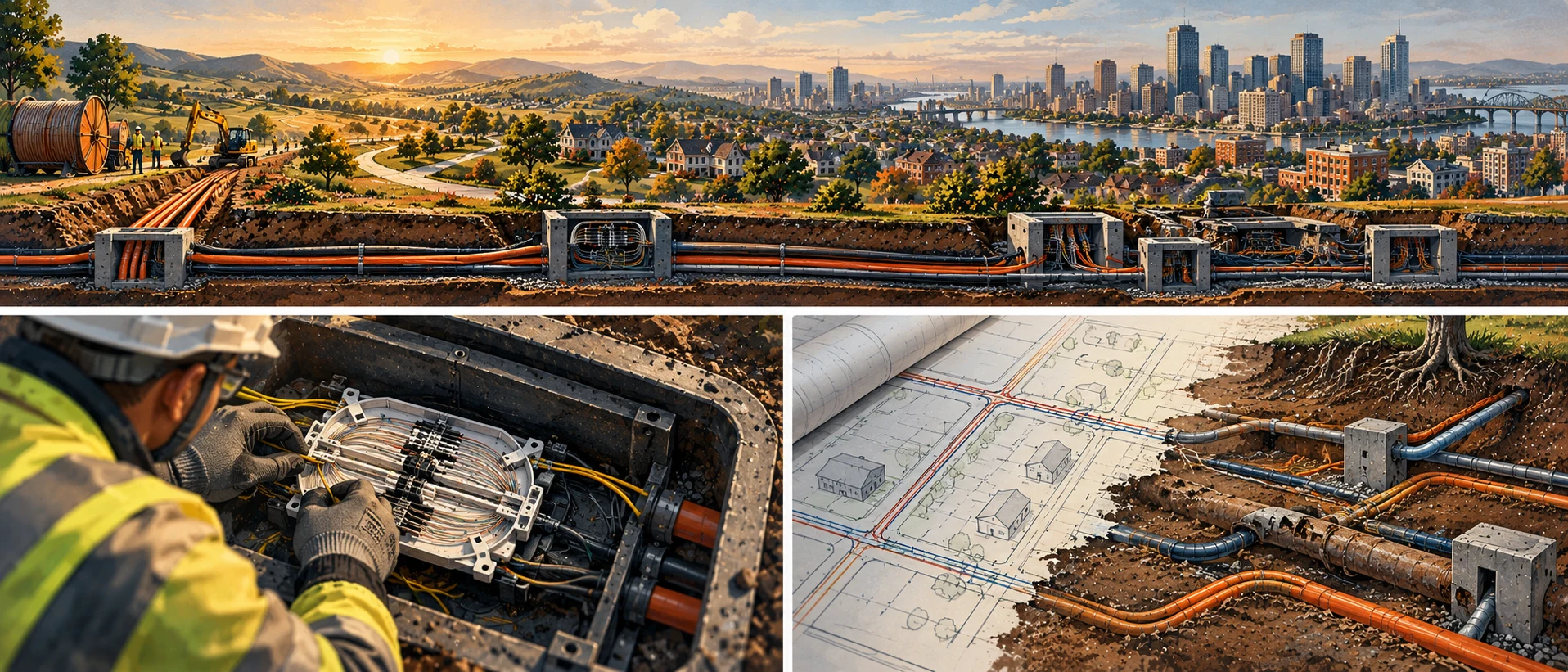
More Management Does Not Create More Experience
When operational performance deteriorates, organizations tend to reach for familiar controls.
Add supervision.
Tighten the SLA.
Increase vendor accountability.
Build another scorecard.
Escalate missed targets.
Bring selected work in-house.
Each can be appropriate.
None instantly creates technical experience.
Insourcing can offer a structural advantage by bringing restoration, repeat performance, customer experience and long-term network condition inside the same operating system. The organization that absorbs tomorrow's repeat has reason to care about the durability of today's repair.
That opportunity for alignment should not be confused with an automatic quality advantage.
Internal teams still operate against productivity expectations, restoration targets, staffing constraints, backlog pressure and budgets. Poorly designed internal metrics can create many of the same behaviors produced by poorly designed contracts.
Contractor models can also support durable maintenance when the commercial structure rewards durable outcomes rather than merely completed transactions.
The employment model changes the incentive architecture.
It does not eliminate the experience curve.
An operator that brings work in-house still has to recruit, train and retain the people who will develop that knowledge.
The same technicians become more valuable as they become more capable. Contractors want them. Competitors want them. Some eventually establish businesses of their own.
The organization therefore has two workforce problems.
It must develop experience.
Then it must retain it.
Contractors face the same economics. Margin pressure can make substantial training investment difficult, particularly when contracts are awarded primarily around unit cost. A person can complete a short fiber-splicing course and learn to make a technically acceptable splice. That does not mean the person has developed the diagnostic judgment required to independently troubleshoot a complicated live-network failure.
Sending inadequately prepared technicians into production transfers part of the contractor's training process onto the operator's network.
Real customers become part of the learning curve.
That is not sustainable either.
Quality Control After Restoration
Quality control should provide another layer of protection.
In many field environments, however, repair QC is heavily centered on whether service has been restored:
Customer online.
Light level within tolerance.
Required photographs uploaded.
Closure information complete.
Those controls establish useful facts about the state of the service at closure.
They may not establish everything about the workmanship that produced it.
A customer can be online after a repair that later fails.
If workmanship-related failures repeatedly survive the prescribed QC process, increasing penalties after the subsequent outage addresses the problem downstream. The customer has already lost service again. Another ticket exists. Another dispatch may be required. Operations has absorbed the additional work.
The better question is what could reasonably have been established before the original repair was accepted.
That does not mean inspecting everything indefinitely.
Additional assurance carries its own cost. A technician can spend hours investigating every marginal condition on a time-and-materials ticket, producing excellent documentation and an operating expense nobody wants to pay.
Quality assurance therefore has to be proportionate to the risk and capable of detecting the defects it is intended to control.
The objective is fewer preventable failures, not simply better accounting after they occur.
Other Mature Fiber Markets Are Already Wrestling With This
The maintenance challenge is not uniquely American.
France offers one of the clearest examples.
As FTTH deployment expanded, French regulator Arcep documented problems including subscribers being disconnected during work to connect other customers, degraded shared fiber infrastructure and poor-quality field interventions.
The response has moved beyond simply counting failures.
Industry work overseen by Arcep has included improved photographic intervention reports, better real-time notification of interventions, field audits, remediation of defective workmanship and efforts to bring information systems back into alignment with actual network conditions.
France has effectively reached a question other mature fiber markets are also approaching:
How do you maintain reliable knowledge of infrastructure being continually touched by many different actors?
Australia is approaching another part of the same problem through fault recurrence and repair reliability.
The United Kingdom has long tracked repeat faults.
Canada has decades of history measuring repeated trouble.
The terminology and operating structures vary. The underlying challenge does not.
As fiber networks mature, maintenance increasingly depends on the industry's ability to preserve technical capability, trustworthy infrastructure information and sufficient evidence about what happens when the plant changes.
Fiber Solved One Problem
None of this undermines the engineering case for fiber.
Quite the opposite.
Passive optical infrastructure removes many of the failure points associated with older network architectures. Fiber offers enormous capacity, long asset life and compelling operating advantages.
But passive infrastructure does not create passive operations.
People still interact with it.
People locate it, splice it, open enclosures, connect customers, interpret test results, update records and decide what to do when something fails.
The next phase of broadband maturity will require more than building additional route miles.
Operators will have to decide how much technical capability they want to retain internally, what they expect contractors to provide, how that capability will be developed, what evidence should survive a repair, how quality should be established, and how network records remain connected to field reality through decades of change.
Those investments can look expensive when viewed individually.
Training costs money.
Quality assurance costs money.
Better records cost money.
Experienced technicians cost more than inexperienced technicians.
The alternative also has a cost. It arrives less neatly, distributed across longer repairs, unnecessary dispatches, repeat failures, customer dissatisfaction, disputed accountability and hours spent rediscovering things the organization once knew.
The broadband industry spent years perfecting the economics of deployment.
The installed base is now asking a different question:
What does it cost to remain good at maintaining what we built?
Fiber is passive.
Maintenance is not.