
Telecommunications·Field Operations
Decision Latency: The Cost Nobody Tracks
How unreliable infrastructure records quietly increase troubleshooting hours, complicate restoration, and contribute to the rising cost of maintaining telecommunications networks.
The Hidden Cost of Operations · Episode 01
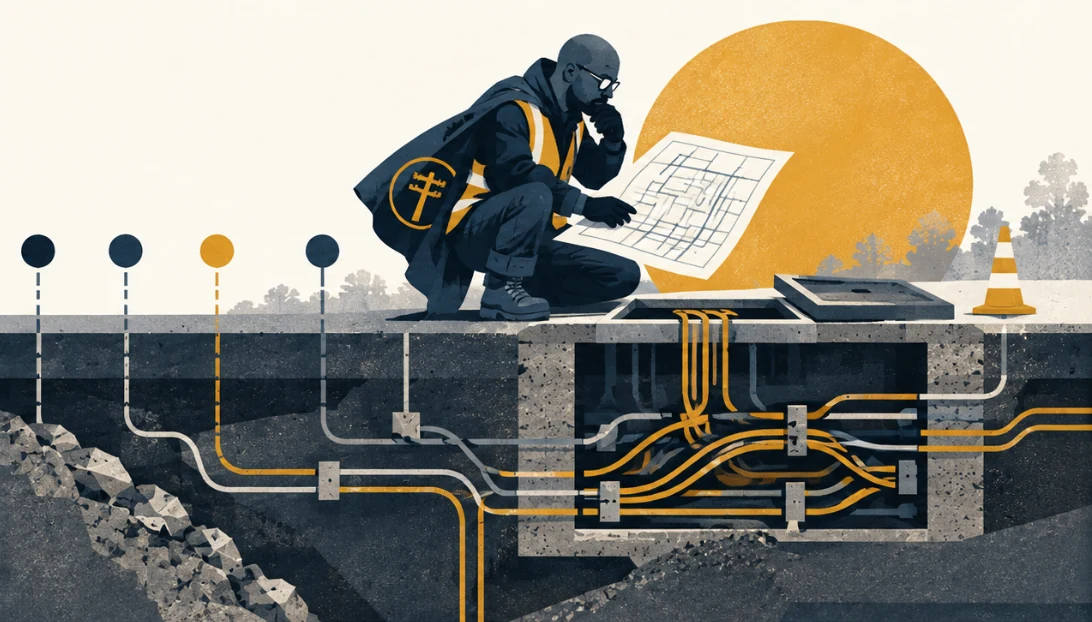
The Repair Before the Repair
A fiber technician arrives at a handhole to investigate a reported service failure. The trouble ticket identifies the affected circuit, and the network records indicate the cable route, splice configuration, and fiber assignments.
But something doesn't add up.
The cable arrangement differs from the drawings. The expected fiber assignments cannot be reconciled with the splice tray. A previous repair may have introduced a configuration change that never made its way into the operational records.
The technician now has two problems: the original fault and the reliability of the information needed to resolve it.
Before proceeding confidently, the technician must establish what actually exists in the field. That may involve additional testing, tracing fibers, reviewing historical tickets, consulting engineering, or investigating adjacent network locations.
All of this takes time.
And in an operating environment where maintenance labor is either directly billed through time and materials (T&M) or consumed from a finite internal workforce, time has a cost.
Yet when the work is completed, those additional hours are likely to appear under troubleshooting, repair labor, or contractor charges.
The records problem that contributed to the expense may never be identified.
Giving the Problem a Name
Decision Latency is the additional time required to make an engineering decision because available infrastructure information cannot be trusted without independent verification.
Every network fault requires diagnosis. Technicians must interpret test results, isolate failures, and determine appropriate corrective actions. That work is part of maintaining a complex physical network.
Decision Latency describes the additional effort introduced when the information supporting those decisions is unreliable.
Consider two technicians investigating similar faults.
One has current records showing the cable configuration, splice assignments, and previous modifications. The other has documentation that conflicts with the physical network.
Both must diagnose the fault. The second must also reconstruct part of the network's engineering history before proceeding.
That additional effort can extend restoration time, increase labor consumption, and delay the availability of resources for other maintenance activities.
Across a large operating footprint, even modest delays can accumulate into significant expenditure.
The challenge is that conventional operational reporting rarely isolates the time spent establishing whether infrastructure records can be trusted.
Where the Cost Gets Buried
Telecommunications maintenance expenditure is influenced by many factors.
Road construction continues to expose buried infrastructure to excavation damage. Shallow plant remains vulnerable to disturbance. Rodent damage, aging infrastructure, and environmental conditions introduce recurring maintenance demands.
The loss of experienced technicians adds another layer of complexity. As institutional knowledge leaves the workforce, activities that once relied on familiarity with local plant conditions may require more investigation, consultation, and field verification.
Unreliable records can compound these pressures.
A cable cut may take longer to isolate because the recorded route differs from the installed route. A splice repair may require additional tracing because fiber assignments were never reconciled following an earlier restoration. A technician may spend an hour reviewing historical work orders before discovering that the documented configuration no longer exists.
These activities consume time without necessarily appearing as separate causes of expenditure.
For contractors operating under T&M arrangements, the additional hours may increase the invoice. For in-house teams, they reduce available maintenance capacity and can extend restoration windows.
Even under fixed-price maintenance contracts, the cost does not disappear. Repeated uncertainty consumes contractor resources and may eventually influence pricing, staffing requirements, or commercial negotiations.
The expense moves through different accounting categories, while the underlying cause remains largely invisible.
Operators can measure what they spend repairing the network without knowing how much they spend figuring out what network they actually have.
When Today's Restoration Becomes Tomorrow's Uncertainty
The consequences can extend beyond the immediate repair.
Under pressure to restore service, a technician may use an available spare fiber, establish an alternate path, or implement a temporary workaround.
These are often legitimate operational decisions. Restoring service promptly is a central responsibility of network maintenance.
The difficulty arises when the resulting changes are not accurately captured and reconciled with the operational record.
The next technician may arrive months later with drawings that no longer reflect the installed configuration. What should have been a straightforward fault investigation becomes another exercise in reconstructing the network.
In some cases, incomplete records can also complicate repeat-fault investigations. Without a reliable history of previous interventions, technicians may struggle to determine whether the current trouble is related to earlier work, an independent failure, or a previously unresolved condition.
Repeat truck rolls have many possible causes, including workmanship, degraded plant, third-party damage, and incomplete diagnosis. Poor records can make those causes harder to distinguish.
Over time, the network accumulates undocumented changes, while successive maintenance teams inherit the burden of discovering them.
The cost of one unresolved discrepancy may be modest. Its operational life can be considerably longer.
The Problem With Conventional Performance Measures
Operations teams are routinely measured against restoration times, productivity targets, repeat rates, and maintenance expenditure.
These measures provide important information about network performance and operational efficiency.
They can also obscure the circumstances under which work is performed.
A technician who spends additional time validating an undocumented splice configuration may appear less productive than one who completes a similar repair quickly.
Yet the additional effort may represent sound engineering diligence.
Likewise, a successful restoration does not necessarily mean the underlying engineering uncertainty has been resolved. Service may be operational while the records remain inaccurate.
When performance reporting focuses primarily on the completed repair, the organization may miss an opportunity to understand why some repairs consistently require more time than others.
A more complete view would examine the quality of the information available when technicians begin their work.
Were the records accurate? Did field conditions match the documented configuration? Was additional verification necessary? Were changes captured before the ticket was closed?
These questions can help distinguish unavoidable troubleshooting complexity from additional work created by unreliable information.
Making Decision Latency Visible
Operators do not need to overhaul their entire maintenance reporting structure to begin investigating Decision Latency.
A targeted review of repair activities could establish how frequently field teams encounter discrepancies between documented and physical infrastructure.
For selected maintenance events, teams could record whether the discrepancy affected troubleshooting, the additional activities required to resolve it, and the approximate time consumed.
The findings would need careful interpretation. Some verification is necessary even when records are accurate, and not every documentation discrepancy delays a repair.
The objective is to identify the incremental effort attributable to information that cannot be relied upon.
Over time, these observations could reveal recurring patterns associated with particular network segments, maintenance histories, contractors, or record-management processes.
They could also provide a stronger financial basis for investing in record reconciliation, engineering documentation, and the preservation of reliable field evidence.
The value of improved records would then extend beyond administrative completeness. It could be evaluated against measurable operational consequences.
The Cost of Engineering Uncertainty
Infrastructure records are often treated as documentation that accompanies the physical network.
In practice, they are part of the operational environment.
Technicians rely on them to locate faults. Engineers use them to plan modifications. Operations managers depend on them to coordinate resources, evaluate risks, and make restoration decisions.
When those records become unreliable, the organization absorbs the consequences through additional investigation, slower decisions, and potentially repeated work.
The expense may be distributed across labor charges, contractor invoices, restoration performance, and future maintenance activities.
That distribution makes the underlying problem difficult to recognize.
Decision Latency provides a way to identify one component of the financial burden created by unreliable infrastructure information.
The next time a repair takes longer than expected, the question should extend beyond what failed in the network.
How much time was spent determining whether the information needed to repair it could be trusted?
Introducing The Hidden Cost of Operations
The Hidden Cost of Operations is a recurring Operations Corner editorial series examining the overlooked practices, engineering uncertainties, and management decisions that influence infrastructure operating costs.
Each installment explores a practical operational challenge, the mechanisms through which costs accumulate, and opportunities for operators to better understand their performance.
Coming next — Episode 02: When the Drawing and the Network Disagree
A field case study exploring how undocumented infrastructure changes complicate fault isolation and extend restoration work.